Once again, The Father of mercies and God of all comfort—focus on 2 Corinthians 1:7

The Amphitheater at Ephesus

The Amphitheater at Ephesus


Since my previous post by this title we have continued studying 2 Corinthians 1:3-11 in two more Thursday night classes, with four or five of us in the room and our three friends joining us by Skype from Seattle, greater Mobile, and Mexico City. We have become acutely aware that Paul is talking about the severe real-life suffering that he has endured in the Roman Province of “Asia” (verse 8) for the sake of Christ. From Acts we know about the riot in the Amphitheater at Ephesus that was caused by the success of Paul’s Asian ministry (Acts 19:21-41). You can see a bit of this Amphitheater in the attached picture.

When we realize the severity of Paul’s suffering—he says that he had “despaired of life” itself—verse 7 becomes all the more shocking: “Our hope for you is unshaken, for we know that as you share in our sufferings, you will also share in our comfort” (ESV). How can Paul be so sure that the Corinthian believers will share in God’s “comfort” because they share in the same kind of sufferings that Paul has endured? Is “suffering” a guarantee of “comfort”?

Paul is confident that the faithful believer will receive God’s “comfort” in the midst of suffering because God is faithful. As the “Father of our Lord Jesus Christ” He is the “Father of mercies” and thus the source of the truest and deepest “comfort.” Since He is the “God who raises the dead” He is able to provide “comfort” for those toward whom “the sufferings of Christ” abound. No situation, however dire, is beyond his reach.

Paul is talking, first of all, about the affliction through which we identify with Christ’s suffering because it is endured for the sake of Christ and in order that we might be faithful. Suffering from other sources, however, may well threaten the faithful endurance of the believer. God’s “comfort” is there first of all in the form of grace and power to faithfully persevere in obedience whatever we may face (verse 6). God’s “comfort” may also be expressed in deliverance from peril and danger, as it was for Paul “in Asia” (verse 8). Resurrection life is the ultimate “comfort” offered by the “God who raises the dead.” As Paul says in verse 9, suffering is the occasion for deepening our trust in God.

I often fret in the middle of difficulties because I cannot see God’s solution (come to think of it, if I could “see” the solution, what need would there be for faith?). Paul, however, would have us take “comfort” in God’s “comfort”—even when we don’t see His solution—because we know He is faithful, and we know that the “Father of mercies” “knows our frame” and “remembers that we are dust” (Psalm 103:14).

The Book Christian Faith in the Old Testament is here!

I was so excited to get the first copies of my book: Christian Faith in the Old Testament: the Bible of the Apostles, Thomas Nelson, February, 2014.
Below is an imaginary interview that highlights the benefit and unique character of this book. I say “imaginary,” because I actually wrote both parts–both the questions, attributed to “Jim,” and the answers, attributed to me.

Christian Faith in the Old Testament: the Bible of the Apostles, Thomas Nelson, 2014, by Gareth Lee Cockerill

Jim: Dr. Cockerill, your book has an interesting title, Christian Faith in the Old Testament: the Bible of the Apostles. Just what is the purpose of this book?
Cockerill: Thanks for asking that question, Jim. I wrote this book to help ordinary Christian lay people understand the Old Testament as a whole and the vital message of each part of the Old Testament. Modern Christians are often woefully ignorant of the Bible’s first thirty-nine books!

Jim: But why is it so important to understand the Old Testament? Doesn’t the New Testament give us all we need to know about Jesus?
Cockerill: To read the New Testament without the old is like reading only the last chapter of a novel. The New Testament claims that what it says about Jesus is the fulfillment of the Old. The Christ of the New Testament fulfills the promise of God to Abraham, the history of God’s Old Testament people, the longings of the Psalms, the message of the Prophets, and more (see, for instance, Luke 24:27 and Acts 17:2-3). In fact, the Old Testament was the only Bible that the first Christians had.

Jim: I see, that is the reason for your sub-title, The Bible of the Apostles.
Cockerill: Yes, the Apostles began preaching Jesus with no Scripture but the Old Testament.

Jim: What led you to write this book?
Cockerill: Jim, for more than thirty years I have been fascinated with the study of how the Bible fits together and especially with the role of the Old Testament. This passion began in the 1970’s when I was doing my Ph.D. at Union Theological Seminary in Virginia. It was fueled by my study of the Book of Hebrews, which draws so heavily on the Old Testament, and nurtured by my teaching of the Bible, both at seminary level here in the United States and while I was serving in Sierra Leone, West Africa. I began to see how grasping the Bible as a whole enriched my understanding of each Biblical book and passage. I saw how comprehension of Scripture’s unity facilitated my students’ understanding. Most of all, I saw how God could use this grasp of the whole Bible to make us more godly.

Jim: I see that you are pretty passionate about the Bible and about its unity! What, exactly, will a lay person get by reading your book?
Cockerill: This book offers three important benefits: (1) The reader will grasp how the Bible as a whole fits together. (2) The reader will come to understand the contribution that each part of the Old Testament makes to the whole. (3) The person who reads this book will gain insight into how each part of the Old Testament applies to us today and helps us live the Christian life. Christian Faith in the Old Testament helps us to identify with God’s people throughout history and to be reshaped by the word of God.

Jim: There are a number of recent books on the meaning of the Old Testament. What makes your book stand out from others?
Cockerill:
• First, this book is written for lay people. It is both understandable and engaging. I was blessed to have several pastors and lay people read the manuscript. Then I took out anything that they did not understand. My son-in-law, Carey Vinzant, who is an excellent stylist, helped me. Thomas Nelson provided excellent editorial service. Furthermore, very chapter has helpful charts and diagrams. My students know that I am very visual!
• Second, the reader can use this book to go straight through his or her Old Testament. Many books on the meaning of the Old Testament rearrange the books in some supposed historical order.
• Third, this book tells you not only how each part of the Old Testament fits into the whole, but how each part applies to us today.

Jim: Great, but is this book only for lay people? What about pastors and students?
Cockerill: This book was written with clarity and without technical jargon for the benefit of lay people. It was, however, written for intelligent people. Theological students and pastors will find it useful for themselves and for ministry. Steve Schellin, Senior Pastor of Southland Community Church, Greenwood, Indiana, has this to say: “As a pastor, Christian Faith in the Old Testament: the Bible of the Apostles really connects with me. I will use this well-written and informative book often in my reading, preaching, and teaching. In addition, I will encourage my congregation to read it! Dr. Cockerill helps everyone to grasp the wholeness of Scripture and provides aids to help us live an obedient life that reflects the full-scope of the bible’s teaching.”

Jim: Dr. Cockerill, just one more question. What about the difficulties that some people find in the Old Testament? Do you deal with them?
Cockerill: Jim, this is not a book about Old Testament “difficulties.” It is my conviction that we cannot deal with these “difficulties” until we have a grasp on the Old Testament’s unity and message. Only then do we have a context for deal with these questions. I have focused on helping people grasp this unity. Occasionally, however, when appropriate, I address problems some have raised about the Old Testament.

Jim: Thanks, Dr. Cockerill, for sharing with us about Christian Faith in the Old Testament: the Bible of the Apostles. We appreciate what you have done to help us deepen our knowledge of Scripture. I look forward to reading this book.
Cockerill: Thanks, Jim, for the encouragement. There is one more thing I would like to say. I have written with a sense of vocation and the conviction that God wanted me to share the insight he has given me with his people. He has confirmed this conviction with what appear to have been a series of miracles—getting the contract for the book in the first place, completing the book on time despite added responsibilities, and getting the fine endorsements for this book from so many people that I respect. It is a privilege to lay this book at the feet of Jesus to use as he wills.

“The Father of Mercies and God of all comfort”

Blessed be the God and Father of our Lord Jesus Christ, the Father of mercies and God of all comfort, who comforts us in all our affliction, so that we may be able to comfort those who are in any affliction, with the comfort with which we ourselves are comforted by God. 2 Cor 1:3-4 (ESV)

Last night’s Wesley Biblical Seminary class on 2 Corinthians was rich. We were studying 2 Cor 2:3-11 using both the English and Greek text. This class is a wonderful mix of people, men and women of various ages involved in various ministry contexts—all motivated to understand and obey God’s word. There were five of us in the room and three more who joined us by Skype—one in Portland, Oregon, one near Mobile, Alabama, and one in Mexico City. Their three faces on the large TV screen at the end of the room reminded us of news correspondents—we had our correspondent on the west coast, our correspondent on the gulf coast, and our correspondent in Mexico City. We, however, were not interested in the evening news, but in the unchanging but every relevant truth of the Gospel found in 2 Corinthians 1:3-11.

Together we traced the logical structure of this passage. The God of all comfort who comforted Paul was also the God who would comfort and sustain the Corinthian Christians in the middle of their sufferings for Christ (2 Cor 1:3-7). Paul adds his own testimony to the faithfulness of God in verses 8-11. He begins by praising the “Father of mercies and God of all comfort” and ends by urging the Corinthians to join in prayer for his deliverance so that, when God delivers, they, along with many others, will give God thanks.

Our study reminded me of that summer day in 1978 when this Scripture became so precious. I said “summer” day, but I should have said “rainy season” day, for we were in Sierra Leone, West Africa. The person who had been mission coordinator had been forced to return to the US because of a heart problem. There was no one else to do the job but me. The responsibilities were intimidating. My wife Rosa, who knows me well, was afraid that the responsibilities would tear me apart. I had taken the former mission coordinator and his wife to the airport—a round trip that took about six hours. The next day I returned to the airport to meet a visiting General Superintendent. His plane was delayed—when it finally came, he wasn’t on it. I arrived back where we were staying about two o’clock in the morning. The next morning I arose late, preparing for another airport run, but began the day by filling the tub with hot water—this was the only place in our mission where we had hot running water. I was going to have a soaker. It seemed a good idea to have my devotions while sitting in the tub. There I was, reading 2 Corinthians 1:3-11 – “Blessed be the God and Father of our Lord Jesus Christ, the Father of mercies and God of all comfort, who comforts us in all our affliction, so that we may be able to comfort those who are in any affliction, with the comfort with which we ourselves are comforted by God. . .” (ESV). “The Father of mercies and the God of all comfort” spoke to me and said, “That’s who I am, and, if you will let me, I will give you the “comfort” you need to “comfort” your colleagues and to do this job I have given you for the next year.” I looked up and said, “Lord, that’s a no brainer. If you will give that comfort, I’ll take it!” God did! The year that followed was one of the best in my life. He gave me strength and joy, he enabled me to support my colleagues, and he blessed our ministry.  At the end of our previous term of missionary service I had gone home sick. After that year of God’s comfort we returned to the states with both health and joy. I bear witness—the God of our Lord Jesus Christ is, indeed, “the Father of mercies and God of all comfort.”

Making the Bible “Relevant”

We often hear people talk about “making the Bible relevant.” It is so easy to begin looking at the passage for Sunday by asking how it applies to the people in my church. What practical application can I make? However, a quick, sometimes superficial, attempt to find the relevance of Scripture often encourages us to import our own ideas into the text and prevents us from listening to what it is actually saying. We do not need to make the Bible relevant—it is relevant—it needs to be heard and understood. We must grasp its consistency, grand story, and the over-all unity of its message (see Christian Faith in the Old Testament http://www.thomasnelson.com/christian-faith-in-the-old-testament.html ). When we have truly comprehended the thrust of Scripture, we will not doubt the importance of its condemnation of sin, offer of redemption, and guidance for life.

There are many facets to the perennial relevance of Scripture. Yes, the Bible addresses the need of the human heart throughout the ages. Yes, the Holy Spirit is continually working through Scripture guiding the people of God. There is, however, one aspect of this continuing relevance that often eludes us. We know that the Bible finds its center in Christ. He fulfills the Old Testament. The New Testament bears witness to Him. We tend, however, to limit this Christ-centeredness to the Christ who lived on earth some two thousand years ago. However, the Christ who took on our humanity, lived an obedient life, offered Himself on the cross, and rose from the dead, is now seated at God’s right hand as our all-sufficient Savior! The Bible is relevant because it finds its fulfillment in and bears witness to an ever-contemporary reality.

This insight came to me through my study of (you guessed it!) the Book of Hebrews. Last September I had the privilege and honor of giving a lecture on this subject at the Henry Center for Theological Understanding, Trinity Evangelical Divinity School. If you are interested, I invite you to listen to “‘Do not Refuse the One Who is Speaking’ (Heb 12:25): Hebrews and Contemporary Preaching” at  http://henrycenter.tiu.edu/resource/do-not-refuse-the-one-who-is-speaking-heb-1225-hebrews-and-contemporary-preaching/ I cannot adequately express my appreciation to Dr. Tom McCall, Geoffrey Fulkerson, and many others who made my visit to the Henry Center and to TEDS very pleasant.

Finishing Well!


Today Rosa and I stood at the graveside of our dear missionary friend Ruth Pierson, with Chuck, her husband of more than 40 years, and her family. It was a  bone-chilling, dreary Michigan day with about a foot of snow on the ground. How good it was to hear Christ’s words pronounced by the minister: “I am the resurrection and the life,” and to know that the chill of death has been removed forever for those who await his coming. By his passion he has melted the cold hopelessness of life without God.

Ruth and Rosa had much in common. Fort starters, both served for three years in Sierra Leone as single missionary nurses, then came home, got married, and took their husbands back with them–Ruth brought Church and Rosa brought me. Rosa always looked forward to the times when we could visit with Chuck and Ruth.

It was a joy to fellowship with our many missionary friends who came to celebrate Ruth’s home going and to  share  our memories of her. Her faithfulness reminds us that the only life worth living is a life of trust in and obedience to Christ. Ruth has finished her course, kept the faith, and heard Christ’s “well done.” Her life beacons us to run the race with perseverance until we finish well! 

“Mango” Christmases–the Best I Ever Had

Well, I’ve been away for some time. My children and grandchildren who live in Central Asia have been home for Thanksgiving and Christmas. We had a great Christmas together. Our family saw them off at the airport today. Their return to Asia reminded me of our “Mango” Christmases in Africa when our children were young.

When I went to Sierra Leone, West Africa, I thought that Christmas in America would be one of the things I missed most. How mistaken I was. Some of my family’s best Christmases were our African “mango” Christmases. Christmas there was uncomplicated. There was little commercialism or shopping bustle. Gifts were simple–and meaningful. One year I made doll houses for our daughters–out of five-eight inch plywood! Those doll houses had to be sturdy enough to ride in the back of a pickup over bumpy roads! Some of the paint wasn’t quite dry Christmas morning. Then there were the Christmas carols. Our Sierra Leonean friends–and others who didn’t even know us–would come around at night singing Christmas carols, sometimes late at night. One night about eleven o’clock members of the brass band from the local teachers’ college showed up at our doorstep playing the familiar songs about Christ’s birth. Of course we got up and “thanked” them.

It was in Sierra Leone–on our eldest daughter’s first Christmas–that we began our long standing tradition of having Jesus’ Birthday Party on Christmas eve! Over the years we have invited all sorts of people to this party. The cake has been different every year. Some of those cakes have become famous. However, it has never been just a birthday party–it has always been a celebration of the Incarnation. Every year we explain–in child-friendly language–that we celebrate Christmas because on that first Christmas God’s Son became a human being like us!

And Christmas day–O, Christmas Day in Sierra Leone. Of course we opened presents, but then it was off to a wonderful Church service, that lasted from two to three hours. Everyone came in new clothes. There would be singing groups and testimonies. It was a joyful celebration of our Lord’s birth. Then, when we lived in a village, all of the believers ate Christmas dinner together. We would invite passers-by to join us. When we lived in town, people sent special Christmas dinners to each other–we would usually get dinners from about three of the best cooks around! The best Sierra Leonean food you could put in your mouth! We discovered that Sierra Leoneans liked popcorn. So we usually made traditional popcorn balls of different colors and sent them to our friends. They were always a big hit.

Those Sierra Leone “mango” Christmases taught me and my family to keep our focus on the true meaning of Christmas–the unspeakably wonderful incarnation of the Son of God. They helped to insulate us against the superficiality of the so-called “holiday season.” Thus, thank God, they have made all of our subsequent Christmases more joyful, as we wait the return in Glory of the one born in a manger.

Road Trip Adventures

Life has been so hectic that I haven’t blogged for over a week. The last post was made from Buffalo, Wyoming, Rosa my wife’s home town. We were visiting along with Ginny and Kate our daughters, David our son-in-law, Kate’s husband, and three grandchildren. Our return trip was quite an adventure. We left early due to a threatened blizzard. About one o’clock last Tuesday morning a fox ran across the road and we hit him. There didn’t appear to be any damage. Later I looked up from a seat in the second row and saw that the van was overheated. It began to sound funny. We stopped at Saint Joseph, Missouri for the night. Rosa contacted our insurance the next morning while I taught a course by Skype. The fox had put a hole in the radiator. After a new radiator and air conditioning condenser, we were on the road again–by now it was Tuesday night. After about three hundred miles the van began to heat up again. We stopped and added coolant. Smoke was billowing out of the exhaust–not a good sign. We had just gone around Memphis and gotten into Mississippi when it began to heat up again. This time coolant didn’t help much. We ended up about four in the morning off the interstate at Como, Mississippi, just south of Senatobia. There wasn’t anything at the Como exit. AAA helped us get a rental car in Senatobia. The tow truck driver took everybody to McDonalds until the car rental place opened–everybody except me, that is. I rode the last 162 mile to Paul Moak Honda in Jackson in the front of the tow truck. For the want of a nail, a horse was lost. For the want of a horse, a rider was lost. For the want of a rider, the battle was lost. For the want of the battle, the war was lost.  Well, for the sake of a fox . . . an engine was lost. The bad news is, the van is sitting at the dealership awaiting a new engine. The good news is, insurance is paying for the engine. I wonder if anyone else has ever had a road trip like this one?Image

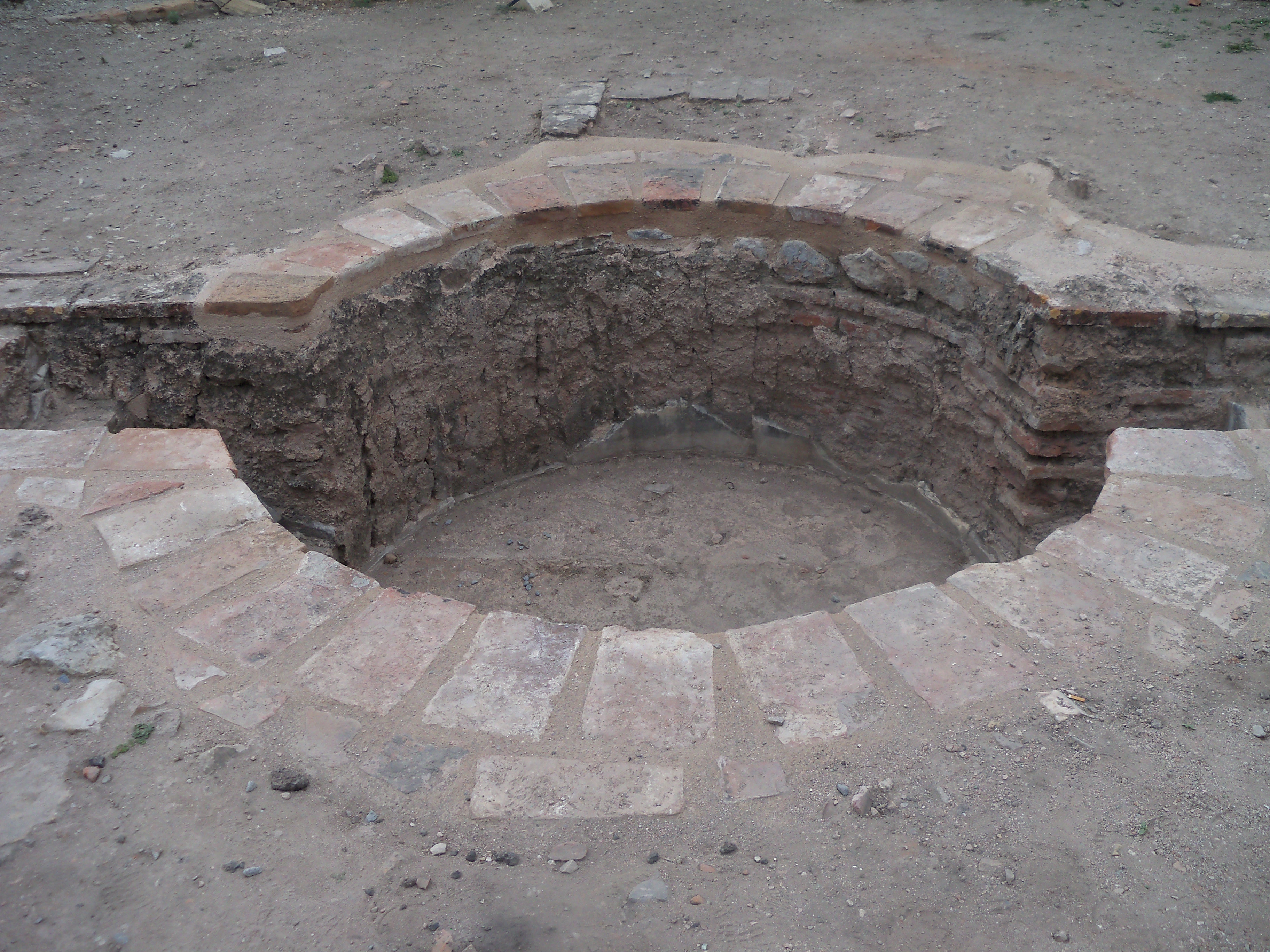
Now, as for the topic of the last post–baptism. We posted a picture of the baptismal pool at the Basilica of Saint John in Ephesus. At the ruins of the church where the Council of Ephesus was held in the fifth century, there is a baptismal pool very much like the one at Saint John’s church. See the picture above.  It appears that such pools may have been typical of fifth and sixth century churches in Asia Minor.


Visit to an Ancient Church–Part Two: The Baptistry

One of the most interesting parts of Saint John’s Basilica was the baptistry.  It was a small eight-sided structure attached to the side of the main part of the church. On one side was a worship center for the ceremony before the baptism. From that center steps descended into the baptismal pool. Steps ascended from the other side of the pool to another worship center for the ceremony that followed the actual baptism. See this picture taken of Rosa and me standing in the pool. I left thinking about what this arrangement suggested concerning the meaning of baptism. How was your baptism like or different from what Saint John’s baptistry might suggest?

 Image

A Visit to an Ancient Church

The ruins of the Basicilica of Saint John were a short walk from our bed and breakfast. This remarkable church was built at Ephesus by Justinian and Theodora, the great Byzintine sixth century Emperor and Empress. It commemorates the reputed burial place of the Apostle John, who spent his last days in Ephesus. We spent a wonderful afternoon walking over this I fascinating sight. A few of the columns, that once supported the six-dome, cross-shaped structure of this sanctuary still stand. Image