God’s Design: The Human Story (Genesis 2:3–25)

This is a recording of the Sunday School lesson given in the Beginnings Class, Clinton Methodist Church, Sunday, June 23, 2024. It is the second lesson in a series on the opening chapters of Genesis. It is being made available here especially for members of the class who were absent. Of course anyone is welcome to listen! I’ve also attache a pdf copy of the handout we used in class for your convenience.

Episode #5: “THE END GAME” Hebrews 12:1–4

Last Wednesday, Sept 29, 2022, I had the privilege of speaking in the chapel service in Hughes Auditorium of Asbury University.

The title was “Episode #5: “The End Game” Hebrews 12:1–4. “

“And let us run with perseverance the race marked out for us, fixing our eyes on Jesus” (Heb 12:1b–2a).

In the words of Kate Wilkinson’s hymn, “May the Mind of Christ My Savior” (an old Asbury favorite): “May I run the race before me, Strong and brave to face the foe, Looking only unto Jesus As I onward go.”

Click here to go to the page where you can view this chapel session by live stream or listen as a podcast. https://www.asbury.edu/podcasts/102396/

Click here to go directly to the podcast. https://www.asbury.edu/wp-content/uploads/2022/09/2022.09.28_Chapel_GCockerill.mp3

“Created Equal” or Created in “the Image of God”?

“We hold these truths to be self-evident, that all men are created equal, that they are endowed by their Creator with certain inalienable rights . . .” These hallowed words from the Declaration of Independence are the very core of the American ethos. The principle they express is enshrined in our Constitution with its Bill of Rights. Indeed, these words are engraved on every American heart. They have been the standard by which we judge our conduct. Without them there would have been no abolition, no women’s suffrage, and no Civil Rights Movement. They continue to call us to account for the condition of Native Americans and for the perennial struggle for racial justice. They protect the weak from the strong and create a space for every human life. 

For most of my life I more or less associated, with little reflection, this principle of creation equality with the Bible’s affirmation that humanity had been created in “the image of  God.” Then it dawned on me that creation in the divine image and created equal were two very different principles. To begin with, one was based on our relationship to God, the other, despite the word “created,” on our horizontal relationships. The one showed me how I was to treat my fellow human beings, the other, how I expected them to treat me. For, indeed, honesty demands that we also acknowledge the negative impact of the principle of creation equality.  This approach has often fostered a self-centered ethic, an ethic that focuses on “my” rights, on what you owe me, instead of my obligations to you. It has been used to sanction acquiring every advantage for myself with little consideration for others—because it was “my right” to do so. 

So, while we acknowledge the good that has come from the principle of creation equality, I suggest that the Bible calls us to a higher ethical standard. It calls us to treat others as creatures made “in the image of God.” It calls on us to “love our neighbors as ourselves.” “Next to the Blessed Sacrament itself, your neighbour is the holiest object presented to your senses” (C. S. Lewis, from the last paragraph of “The Weight of Glory.”) 

“Does Same-Sex Practice have a Negative Medical and Social Impact on Society?” Podcast 10 in the series entitled “An Issue for Our Time: the Bible and Same-Sex Practice.”

“Apart from Romans 1:24-27, the New Testament Doesn’t Say Anything about Same-Sex Practice, Does it?” Podcast 8 in the series, “An Issue for Our Time: the Bible and Same-Sex Practice.”

You’ve heard people say that same-sex practice is a minor or side issue in the New Testament? Well, in today’s ten-minute podcast, we have a look at that question. You can listen to “Apart from Romans 1:24-27, the New Testament Doesn’t Say Anything about Same-Sex Practice, Does it?” by clicking here and then by clicking on podcast 8.

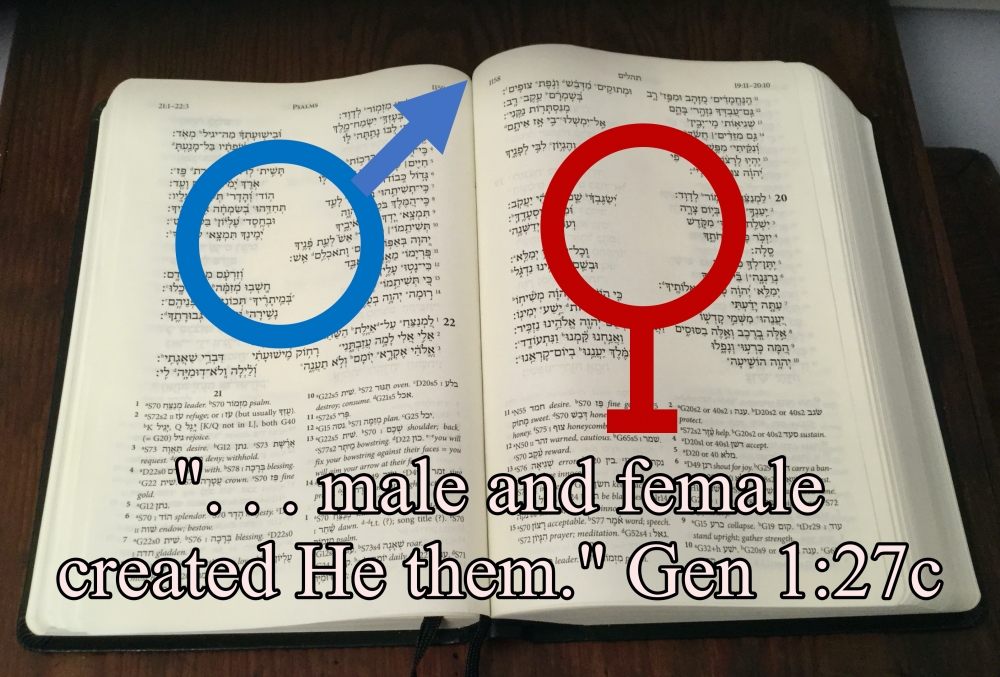
Listen to “The Creation Account: Created ‘Male and Female.'” Third in the podcast series, “An Issue for Our Time: The Bible and Same-Sex Practice.”

Male and Female2

Podcast #3 in the series “An Issue for Our Time: The Bible and Same-Sex Practice,” is now available. In this podcast, entitled “The Creation Account: Created ‘Male and Female’ (Genesis 1:1–2:25),” we begin our study of what the Bible says about this issue. The opening chapters of Genesis are crucial because they lay a solid foundation for all that the Bible has to say about sexuality.

These podcasts are located on the page entitled “An Issue for Our Time: the Bible and Same-Sex Practice. A Series of Podcasts” under the main menu. You can access them by clicking here.

“People of the Lie.” Further Thoughts on Holiness.

(I have moved the pod casts about holiness that were posted to this home page on March 8 and 15 to a newly created page entitled “Holiness.”

  1. If you want to access those podcasts, click on “Holiness” in the menu bar above.
  2. If you want to access the blogs of February 15 and 22 to which this post refers, click “Holiness” in the “categories” list to the right. Clicking there will show you the posts for February 15, February 22, and March 2 along with this post for April 26.)

Unconfessed Sin . . .

Scott Peck’s article “People of the Lie,” in The High Calling (pages 2 and 5 of the March-April issue, to access this issue click here ) recalled the concern I expressed in the February 22 blog about the tragedy of unconfessed sin in the Wesleyan-Holiness movement. In that blog I suggested that the claim to be “without sin,” though nuanced, has often, in fact, led to unconfessed sin in the lives of people who professed to be holy.  In Peck’s article, which is taken from his 1983 book by the same title, he argues that refusal to admit that we have sin allows sin to go unchecked and produces wickedness. Peck writes as a psychiatrist, but his insight rings true in Christian experience.

produces wickedness . . .

It was Peck’s use of the word “wicked” that got my attention. When I began to reflect on my life-long experience within the Wesleyan-Holiness movement, it appeared that much behavior had been motivated by un-crucified self-centeredness. This seemed to be true not just in one context or institution, but in a broad range of contexts. Even when maintaining certain standards pertaining to matters of dress or entertainment, we have often let things like criticism of others, intimidation, flattery, manipulation, shading of the truth to protect our own image, insistence on one’s own way (often invoking “Biblical” authority), refusal to be reconciled, and refusal to ask for or give forgiveness, go unchecked. Does this list remind you of the “works of the flesh” in Galatians 5:19-21? We have also often failed to be “deeply kind, tender hearted, graciously forgiving one another and making allowance for one another as God in Christ has forgiven us” (Eph 4:32). We have not been “imitators of God, as dear children, walking in love as Christ also loved us and gave Himself for us . . .” and thus we have not been “an odor of sweetness” before God (Eph 5:1-2, my own translation of these verses).

which leads to hypocrisy and abuse . . .

Indeed, Peck is correct. Our failure to admit the presence of sin has led to “wickedness.” In our case, often to a hypocrisy in which holiness was defined by certain external standards while sins of the flesh and spirit were ignored provided people used the right words when talking about “holiness.” As per the February 22 blog, this situation has been exacerbated by a superficial approach to sanctification which prematurely called people to a “second experience.” The result was the short-circuiting of a true death to self-centeredness and thus failure to experience genuine fullness of the Spirit and surrender to the lordship of Christ (blog of February 15). When leaders have acted in this way there has been much harm to the body of Christ and to the people under their care, sometimes causing them to turn away from the Lord. One might dare to use the word “abuse.” Scot Peck’s article helped me see the seriousness of this situation, which my former colleague, Dr. Carey Vinzant, has been raising for several years.  We have too often claimed holiness, while actually practicing wickedness.

and calls for true repentance.

In my blog of February 22, I suggested some changes in the way we think about and articulate God’s call for holiness in order to address these concerns. I am still convinced that we need to do some hard re-thinking, re-examining of Scripture, and re-articulation along the lines suggested. However, now I am also convinced that something even more radical is necessary. Sin requires repentance, restitution, and change. (That sentence is intentionally redundant for emphasis—restitution and change are part of true repentance.) God calls us (I’m including myself) to humbly seek His forgiveness and, by the power of His Spirit, to change and to bring healing and restitution to those who have been hurt. Did not the Asbury revivals come when people who claimed to be holy repented of their sin? It is time for triumphalism to end.

Peck’s article was the final link in a chain that has clarified my thinking. Many thanks to the Francis Asbury Society, and to the editor Stan Key, for publishing this article in The High Calling.



Holiness Unto the Lord. Part Three: Hope for the People of God.

“Made for Holiness,” podcast #1 in the series on the Biblical Basis for Christian Holiness

“Lord, you have removed sin’s guilt from us so that we will not die for it as a crime. Now break sin’s power in us so we do not die from it as a disease. Help us put sin to death. Rom. 8: 13.” (Matthew Henry, A Way to Pray, edited and revised by O. Palmer Robertson, Edinburgh: Banner of Truth Trust, 2010, p. 91). What a wonderful prayer for the people of God!

This prayer shows awareness of sins debilitating power and expresses urgency for deliverance. How the contemporary church needs to regain this awareness and urgency. Many seem to feel that, provided one has made a “decision” for Christ, sin doesn’t much matter. This situation is little different from the abuse of indulgences that Martin Luther faced in the sixteenth century—except then people actually had to pay something for their false assurance. Is it any surprise that the behavior of Christians differs little from that of unbelievers or that Christian leaders fall into open sin?

The Wesleyan movement has the potential to proclaim an alternate, more Biblical vision of salvation that offers health to the church at large. A small and ever-shrinking minority from our movement still clings to the formulaic understanding described in my last blog. Their approach has little that is attractive for most people seeking to know God more deeply. One student from a non-Wesleyan background told me that they were attracted to Wesley Biblical Seminary by disillusionment with the cheap grace they had been taught and by a desire for holiness, but were then alienated by the formulaic approach to holiness that made claims not reflected in the life of the community. The rest of the Wesleyan movement speaks with an often confused and ambivalent voice.

Several years ago, I was talking with a very distinguish and capable leader of one of the Wesleyan denominations. He told me that his denomination had abandoned the old way of looking at holiness but had not found a new or effective way to communicate the message of God’s transforming grace in the modern world. He also told me that many people viewed Wesley Biblical Seminary as an advocate for that old, ineffective way. I assured him that I followed a different approach and shared with him material from my course “The Biblical Basis for Christian Holiness.”.

Since I am retired, I can no longer speak for the leadership of Wesley Biblical Seminary, and the views I am expressing may not represent their views. However, I began to articulate what I believe to be a Biblical and effective understanding of holiness in the first of these three blogs. I attempted to address some errors in the second. God willing, I plan to continue this teaching with a series of short, 8 to 10 minute podcasts, beginning today. These podcasts will take those interested through the essence of that course on Biblical holiness. Look for a new podcast each Thursday. Be prepare for a fascinating journey through Scripture. You will find the first of these podcasts, “Made for Holiness,” at the top of this blog. Listen today.