“Buy truth, and do not sell it” (Proverbs 23:23) An Urgent Appeal.

 “Buy truth, and do not sell it” (Prov 23:23). When I hear this proverb, two questions come to mind: “Is there anything more important than the truth?” “Am I living in the truth?” How easy it is to justify our own opinions and actions by perverting the truth. We embrace delusion out of perceived self-interest oblivious to the fact that such behavior is always self-defeating. The destructive power of such delusions is multiplied when they are shared with and reinforced by a group. Furthermore, we can always find something online to support what we want to believe. It is so easy to choose what I want to believe rather than to seek for the truth.

The burden of proof is the responsibility of those who make such a claim. What kind of proof could substantiate this accusation?

First of all, the perpetual, ceaseless, loud insistence that the election was stolen is no proof. “Thou dost protest too much.” One way to convince people of a lie is to repeat it loudly, confidently, and publicly. Such behavior should always raise the suspicion of thinking people.

Furthermore, YouTube videos and random statements online do not constitute evidence unless they are vetted in a court of law. Otherwise, they come under the category of hearsay and gossip. The internet is filled with fake videos.

Our freedom is based on the rule of law. Thus, if there had been evidence that the election was stolen, it should have been presented in court and evaluated in accordance with the laws of the United States. There is no reason to believe that Trump would not have received a fair hearing in the courts. The Supreme Court was (and is) dominated by Trump appointees. He had appointed many judges to lower courts. His party controlled the Senate which might have been another venue for legal review. Yet his legal team never presented anything like convincing evidence in any court. His own attorney general said that there was no evidence of corruption sufficient to change the results of the election. To continue to insist that the election was stolen without presenting such evidence is indeed to lie. M. Scott Peck describes this kind of behavior well: “the malignantly narcissistic insist upon ‘affirmation independent of all findings.’” (People of the Lie, p. 80, quoting Martin Buber, Good and Evil, p. 136, emphases added).

This lie has become a corrupting influence pervading everything that this administration does and compromising its integrity. The President repeats this lie in his speeches. He even reiterated his claim that the election had been stolen in his recent speech at the National Prayer Breakfast. Furthermore, he insists that everyone who is part of his administration affirm this lie. 

So, what is the bottom line? 

First, Trump has set himself up as the determiner of truth. Truth is not based on evidence. Truth is what Trump says it is.

Second, his demand that everyone must affirm this lie exposes the absolute loyalty that he demands of his followers. 

My friends, the biblical definition of an anti-Christ is one who comes with deceit and demands for himself the loyalty that belongs to Christ alone! I urge my Trump-devoted friends who profess Christ to return to their first love. Remember, it is Jesus alone who can say: “I am the way, the truth, and the life” (John 14:6). He also said, “you will know the truth, and the truth will set you free” (John 8:32). “Buy truth, and do not sell it.”

What Is the Annual National Prayer Breakfast For?

This quotation is on the webpage of the National Prayer Breakfast Foundation: 

“Founded in 1953, when President Dwight Eisenhower accepted the invitation to join Members of Congress to break bread together, our annual Breakfast is an opportunity for Members of Congress to pray collectively for our nation, the President of the United States, and other national and international leaders in the spirit of love and reconciliation as Jesus of Nazareth taught 2,000 years ago. Every president, regardless of party or religious persuasion, has joined since. All faiths are welcome.” (https://npbfoundation.com)

In the light of this statement, President Trump’s thirty-five minute speech at the annual national prayer breakfast on Feb 5 was more than inappropriate. It was blasphemous. He used this occasion, dedicated to humbly seeking God’s blessing upon the leaders of the nation and the world, as an opportunity to brag about his wonderful achievements, promote his own agenda, rant by name against those with whom he is currently displeased, and brag about those who are doing his will. (Click here for the President’s speech.) By contrast, the keynote speaker, Tennessee Governor Bill Lee, took a bare fifteen minutes to give a wonderful testimony to the reality of Jesus in the sorrows and challenges of his life. (Click here for his speech.) 

The president bragged that he had done more for “religion” than any other president as if that were a great achievement. He seems not to notice that “religion” is often used as a cover for evil or a means of manipulation. Both Jeremiah and Jesus condemned the “religious” of their day. Followers of Jesus are not concerned about “religion” but about the kind of commitment to Jesus that leads to a life of integrity, mercy, and justice. They are more concerned about being faithful witnesses to Christ than about escaping persecution.

The President showed his ignorance of true Christian faith when he suggested that he might have earned his way to heaven. He said that he had only been joking when he said that he did not think he was going to heaven, but that there was nothing he could do about it. In today’s speech he declared that even though he wasn’t so good himself, he had done enough for good people and for “religion” that he had a chance of making it. It is a terrible thing to promote “religion” as a means of strengthening one’s power and covering one’s sins.

The bad news is, President Trump, that you are wrong. You cannot earn heaven with any number of good works. Salvation is in Christ alone. The good news is, you can do something about it. You can come to Jesus. You can, by his grace, repent of your sexual immorality, rapacious greed, disregard for “the fatherless and the widow” (Deuteronomy 10:18), hostility toward “the stranger that sojourns with you” (Leviticus 19:34), unconcern for those being carried away to death as in Gaza, and neglect of the starving in Cuba and the beleaguered in Ukraine. You can let Jesus replace those things with purity, generosity, kindness, and a concern for mercy and justice that will bless the poor and oppressed of the world.  

Thus says the Lord: “Let not the wise man boast in his wisdom, let not the mighty man boast in his might, let not the rich man boast in his riches, but let him who boasts boast in this, that he understands and knows me, that I am the Lord who practices steadfast love, justice, and righteousness in the earth. For in these things I delight, declares the Lord.” (Jeremiah 9:23–24)

For a more detailed analysis of the National Prayer Breakfast click here.

The Third Mystery?

Sherlock Holmes, with all his powers of observation, will not solve this one!

Along with some ruminations on Adam Hamilton’s Making Sense of the Bible.

Several summers ago a friend and former student dropped by. In the course of our conversation he asked, “How do you explain the Son of God becoming a human fetus?” My answer was something like this: “I don’t explain, I worship.” There are three mysteries at the heart of the Christian faith. Agatha Christi doesn’t write about these mysteries. They are not the kind of mysteries that Sherlock Holmes, with all his powers of observation, could solve, for they are mysteries that pertain to the nature of the infinite God, the Creator of the Universe. First, these mysteries are not based on human speculation but upon divine revelation. Second, they are impenetrable just because they do reveal the one and only infinite God. Third, although we cannot penetrate them, we can, and must, speak rightly about them if we would worship this God aright. The three mysteries are the incarnation of the Son of God, the Trinity, and God’s self-revelation in the Bible. Although the focus of this article is the third mystery—the Bible, we will offer a paragraph on the other two by way of introduction.

The first and central mystery of the Christian faith is the incarnation. The Son of God assumed our humanity without surrendering His deity. Thus the faith affirms that Jesus was and is not half-God, half-human but one hundred percent God and one hundred percent human. The confession of the Christian Church has witnessed to this truth by insisting that, although the incarnate Son of God is one Person, he has both a human and divine nature and a human and divine will. This mystery is at the heart of the Christian faith because the incarnation is God’s ultimate self-revelation and means of redemption. When we speak rightly about it—though with limited comprehension—all the rest of Christian faith—creation, revelation, redemption, and ultimate salvation—come together in a beautiful whole. The earliest Christians confessed the deity and humanity of Christ on the basis of their empirical encounter with him.  The doctrine of the Trinity, what we might call the ultimate mystery of the Christian faith, is based upon and derived from a proper understanding of how we should speak about the incarnation.

Let us turn now to the third mystery—Holy Scripture. As Christ is the incarnate “Word” of God, so the Church has affirmed the Bible to be the written Word of God, the channel through which God’s self-revelation that climaxed in Christ has come to us. Yet it is also obviously the word of human beings. Thus many theologians have used the analogy of the incarnation to speak about the Bible—the Bible, though one grand revelation, is fully the word of God and fully the word of human beings. In his recent book, Making Sense of the Bible, Adam Hamilton has dispensed with this third mystery, the mystery of a divine/human book, by denying that the Bible should be called the Word of God.[1] He argues that the writers of the Bible were no more inspired than people are today when they preach the Gospel. They were, of course, according to Hamilton “closer to the events” the Bible records.[2] Furthermore, the Church throughout the ages bears witness to the significance and usefulness of their writings. Thus Hamilton would still give the Bible a place with some prominence though denying that it is God’s word. It contains eternal truth, it also, according to him, contains instructions that were appropriate only for the time of writing, and, finally, it contains some things that were never binding because they were merely human misconceptions. According to Hamilton, only the incarnate Son of God should be called the “word of God.”

Hamilton’s removal of the mystery—and the tension—of the divine/human book is an instance of simplistic reductionism that solves nothing. Hamilton and others like him often ridicule Evangelical Christians for referring to the “original autographs” of Scripture or to Scripture as “originally given” as the ultimate standard of accuracy since, “we don’t have the autographs.” Yet they make an even more egregious move when they deny the full trustworthiness of Scripture in favor of the incarnate Word, Jesus Christ. Through textual criticism we can be ninety-seven percent certain what the “original autographs” said. We have NO access to the incarnate Word Jesus Christ aside from the Bible in front of us! Indeed, if we did have direct access to Jesus, if we had been his original disciples, that immediacy with Him would not have solved anything. Those earliest disciples were convinced of his deity by his character and actions—the authority of His teaching, of His power over Satan and demons, of his healing, of his control over nature, and especially of His Resurrection.  Yet they knew He was also completely human. I think it is C. S. Lewis who asks somewhere if we are to imagine that Christ never asked a question for which he did not know the answer.  We might add, do we think that he never had a slip of memory, stepped on someone’s toe, or spilled a bucket of water? If so, Lewis goes on to affirm, his humanity was so different from ours that it could hardly be called the same thing. We cannot penetrate the union of the divine and human word in Scripture any more than we can penetrate the theandric union of the divine/human Jesus. Yet to dissolve this Scriptural union is almost as perilous as to dissolve the union of the divine/human Christ.

We must speak rightly about, and live with the tension of, this mystery. The Bible is the Word of God through which God reveals Himself by both word and deed with the purpose of delivering human beings from bondage to sin and bringing them into fellowship with Himself as a new and redeemed people of God. It is an accurate record of God’s revelation in history culminating in Christ, of His redeeming grace, and of his instructions as to how his people are to live in accord with His character. At the same time it is a human word, written over millennia by many people, and thus containing various tensions and seeming contradictions. As the word of God its words have been chosen and arranged through divine oversight to communicate God’s message. As the word of human beings its words and their arrangement reflect the personalities of its writers and the vicissitudes of textual transmission. And yet it is less than accurate to speak of the divine and human in Scripture in separation from one another as we have done in these last sentences. Both are necessary for divine revelation—and ultimately for human redemption. As the human will of the incarnate Christ is subject to the divine, so the humanity of Scripture serves God’s revelatory purpose. Thus the Bible, as the Word of God, when rightly understood in its totality, cannot be relativized by attributing some aspect of its teaching to its human authors apart from God.

[1] Contrary to what Hamilton says, the Bible has been affirmed as the word of God from the beginning of the Christian Church—even if the exact expression has not always been used. It is obvious that Jesus, Paul, and the other New Testament writers believed that the Old Testament was the completely trustworthy revelation of God. Despite Hamilton’s protestations to the contrary, the New Testament writers wrote with the conviction that what they were recording concerning the fulfillment of the Old Testament had authority equal to that which it fulfilled. Hamilton’s argument is particularly faulty when he refers to the Thirty-Nine Articles affirmation that “all things necessary for salvation” are found in Scripture as evidence that the Bible was not thought to be the word of God. All sides in the controversies of the Reformation period believed that the Bible was the completely true word of God—what they disagreed on was the relationship between the Bible and Church tradition.

[2] This is a particularly lame argument. While it is significant that the Gospel writers were close in time to the events they recorded, this argument has little relevance to much (perhaps most) of the Bible. Even the Chronicles, which were books of historical narrative, were written several hundred years after the most recent events that they record.

From the Introduction

Christian Faith in the Old Testament: the Bible of the Apostles

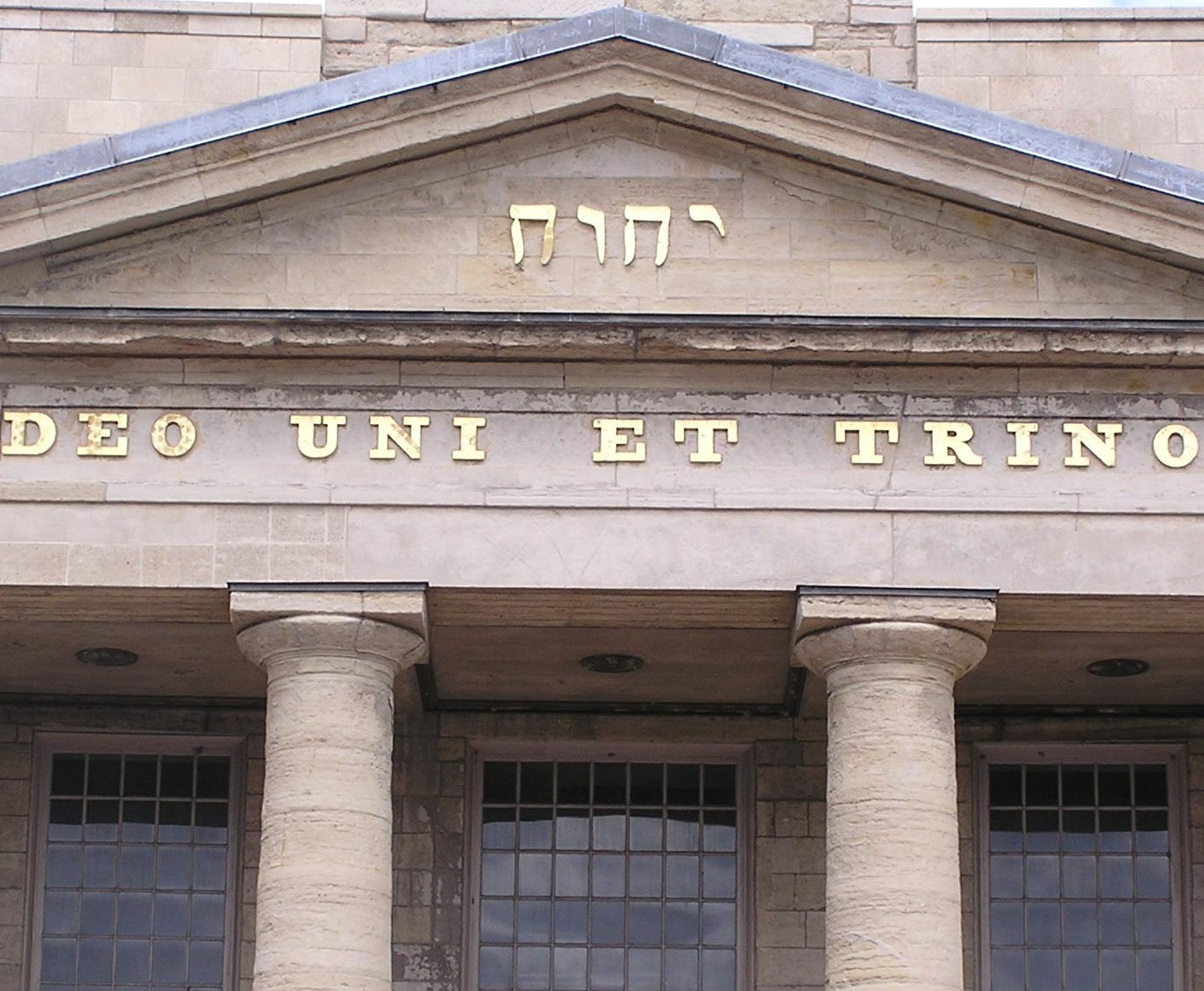
The inscription high above the door of the old Roman Catholic Cathedral in St. Louis caught my attention. After the construction of the new Cathedral the Pope designated this historic church as the Basilica of St. Louis, the King of France. This inscription was not only in the expected Latin, but also in Hebrew! At the top were clear, gold, Hebrew letters that formed the OT covenant name of God—hwhy. This was the name by which God revealed Himself to Moses in Exodus three—“Jehovah,” or, more accurately, “Yahweh”—“I Am.” Below this Hebrew word came the following Latin inscription, still in letters of gold: “Deo Uni et Trino,” “to God One and Triune.”

OLYMPUS DIGITAL CAMERA

Before I saw the Latin I thought that I was looking at a synagogue. Then I recognized the appropriateness of joining these two inscriptions. Christians have always affirmed that the God they know as Triune through the coming of the Lord Jesus Christ is a fuller revelation of the God of the Old Testament. Their God was the Creator who made covenant with Abraham, Isaac, and Jacob and delivered their descendants from slavery in Egypt. In controversy with the Gnostics, Irenaeus and other Christian writers resolutely affirmed that the Father of our Lord Jesus Christ was the Creator/Covenant making God of the Old Testament. He had revealed Himself in His co-eternal Son and was at work in the world through the equally co-eternal Holy Spirit. This truth is affirmed by the Apostles’ Creed:  “I believe in God, the Father, almighty, maker of heaven and earth; and in His only begotten Son, Jesus Christ . . . . I believe in the Holy Spirit . . .”

In fact, continuity with the Old Testament is the bedrock of the New Testament, stated or assumed on every page. Jesus “beginning at Moses and all the Prophets, expounded to them in all the scriptures the things concerning himself” (Luke 24:27; cf. 24:44-48). God, who “at various times and in various ways spoke to our forefathers through the prophets, has now spoken to us in one who is Son” (Heb 1:1). Paul “reasoned with them from the scriptures, explaining and demonstrating that the Christ had to suffer and rise again from the dead, and saying, ‘This Jesus whom I preach to you is the Christ’”(Acts 17:2-3).

The Old Testament was, in deed, The Apostles’ Bible. It was the Bible of those earliest Christians, the Bible of the New Testament writers. They were thoroughly convinced that in it God had revealed the salvation they now knew in Christ. Christ was the God-intended fulfillment of its story, of its promises, of its prophecies, and of its types. They understand the fullness of the Old Testament through Christ. They grasped Christ’s identity and significance for the world through the Old Testament. The Gospel writers believed that this perspective had its origin in Jesus.

Modern Christians, on the other hand, are often ignorant of the Old Testament and its significance. For some it is, at best, historical background for the New. For others it is a collection of primitive stories, now superseded in Christ. Some avoid it because it is hard to understand or because some parts of it seem incredible or morally problematic. We read Psalms for comfort, Proverbs for wisdom (after all, we can get these two books bound at the back of our New Testaments), teach (some of) the stories of Abraham and Moses in Sunday School, and read Isaiah at Christmas time. We have lost The Apostles’ Bible, and, in so doing we have lost much. We end up with an anemic view of Christ, a superficial understanding of the atonement, and an individualistic view of the church. Our God shrinks because we no longer see the majesty of his creation, the grandeur of his work in history, or the glory of his salvation in Christ. We have little basis for social ethics. We live in rootless isolation because we no longer see ourselves as children of Abraham, part of the people of God, stretched out in history and on its way to glory. If we do not have The Apostles’ Bible, we will not have the true apostolic faith.

This book is dedicated to helping ordinary, intelligent modern Christians re-establish their apostolic roots in the Old Testament, The Apostles’ Bible. First, the pages that follow are designed to helping the reader understand how each major part of the Old Testament fits into the total scope of Biblical revelation. Second, this study gives needed guidance concerning the way in which each part of the Old Testament applies to contemporary believers. How do the various section of the Old Testament, given before Christ, function as Scripture for people who live after Christ’s coming?